
In this post I will try to explain how to calculate how hard your ice cream will be and what affects the hardness.
Ice Cream
First lets look at what ice cream really is. Ice cream is a mixture of water, air, fats, proteins, sweeteners, emulsifiers, flavors and sometimes stabilizers.
When calculating ice cream mixes we also need to explain solids.
Solids are everything that is not water and we can define a few different types of solids.
– Total solids is everything in the mix that is not water.
– Total solids not fat or TSNF is everything in the mix that is not water or fat
– Milks solids not fat or MSNF is the solids from milk and cream that is not fat. This includes lactose and milk proteins and minerals.
In a basic ice cream base of milk, cream, egg yolks and sugar the different ingredients contribute like this.
– Milk and Cream adds water, fats and MSNF
– Egg yolks adds water, fats, emulsifiers and solids
– Sugar adds solids
A typical ice cream will have 40%-50% solids and 50%-60% water. Gelato usually have 35-40% solids.
What affects hardness?
– Temperature
– Sugars
– Overrun
– Other factors
There are many factors that affects how hard the ice cream is at a certain temperature. How much air or overrun the ice cream has, how small the ice crystals are but the main factor is how much water and sugar is in the ice cream.
The amount of water in your ice cream and how much of the water that is frozen controls hardness.
Pure water freezes to ice so why doesn’t you ice cream do that?
The answer is sugar. When you add sugars to your ice cream the sugar will lower the freezing point of the water. This means that the water will start to freeze to ice at a lower temperature compared to pure water. And all water does not freeze instantly, it’s a dynamic process. When the water start to freeze the concentration of sugars will increase in the still unfrozen water. This means you will need a lower temperature to freeze the remaining unfrozen water. And so on.
So, just add more sugar and the ice cream will be softer? Yes.
Temperature
Homemade ice cream will usually be hard straight out of the freezer. This is also true for most premium brand ice creams like Häagen-Dazs etc. A domestic freezer should hold at least -18C/0F but your freezer might be even colder than that.
So, an ice cream designed to be scoopable at say -14C/6.8F will be hard out of the freezer and you need to temper the ice cream for a few minutes before serving.
The best method is to let it temper in a fridge for 15-30 minutes. How long depends on the ice creams hardness and the temperature of your freezer.
Sugars
Adding more sugar will make your ice cream softer. The problem is that your ice cream will also be sweeter. The trick is to use different kinds of sugars to be able to control both the hardness and the sweetness of your ice cream.
Sucrose
When we say sugar we usually mean sucrose. Sucrose is by far the most well known sugar and this is also the sugar that we will compare all the other sugars to. Sucrose is known as white sugar, table sugar, granulated sugar or regular sugar. Sucrose is a disaccharide composed of two monosaccharides glucose and fructose.
PAC and POD
We now have to introduce PAC and POD.
POD or relative sweetness is just how sweet a sugar is compared to sucrose.
Sucrose has a value of 100. If this value is lower it is less sweet and if it is higher it is more sweet.
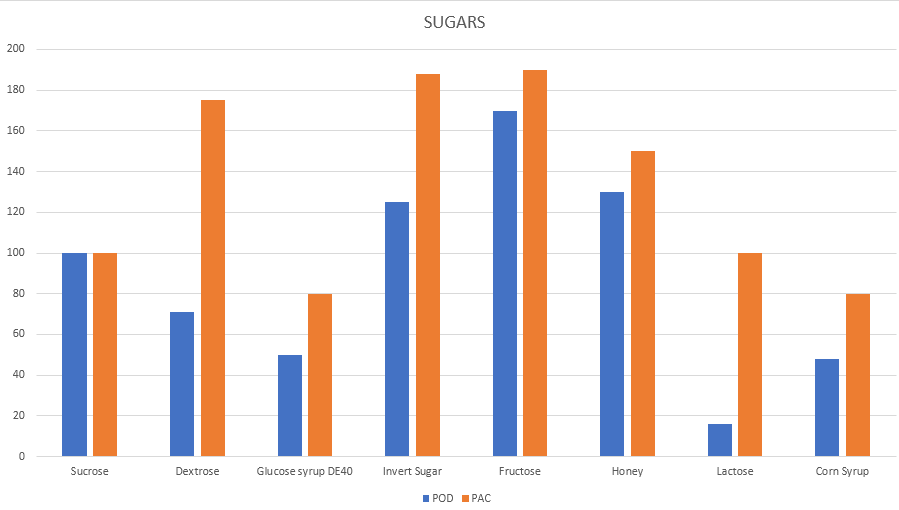
PAC or Freezing Point Depression Factor FDPF is a measure of how much a sugar will affect the freezing point of water. Also here sucrose has a value of 100. If the PAC is lower it will have less effect and if it is higher it will depress the freezing point more. The science behind this has to do with the molecular weight of the sugar molecules. The smaller the molecule the more it will depress the freezing point. This is why the monosaccharides like dextrose and fructose have a higher PAC than sucrose. The molar mass of sucrose is 342 g/mol and the molar mass of for example fructose is 180 g/mol. If we take 342/180 we get 1.9. This means fructose has a PAC of 190 and it depresses the freezing point almost twice compared to sucrose.
Here is a short list of the most common sugars that is used when making ice cream.

Freezing Curve
The more water that is frozen the harder the ice cream will be. So, we need to figure out how much water is frozen. To do this we need to first figure out the freezing point of the ice cream. The freezing point is when the water in the ice cream starts to freeze to ice.
If we calculate the total PAC for our ice cream mix and divide that with the water we get what is called a Normalized PAC, you can think of this as the concentration of sugars in the water part of the mix. When we have this concentration we can use a table to calculate the initial freezing point of the mix. This table lists the freezing point of different concentrations of sucrose solutions, Ice Cream 7th Edititon by Goff, Hartel.
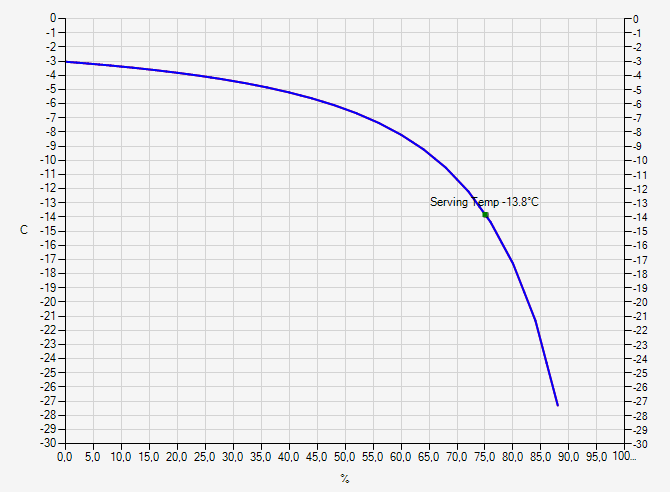
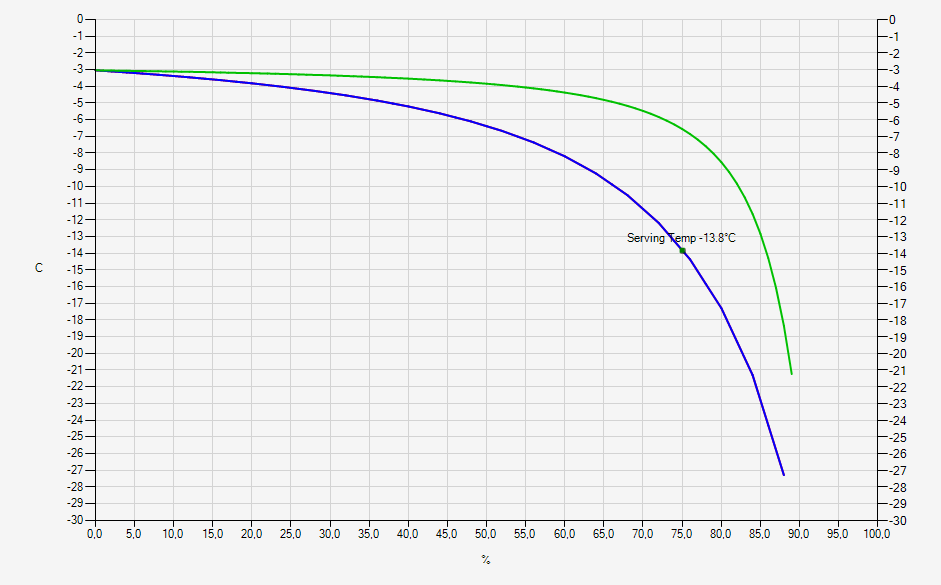
By using regression and simulating that more and more water is frozen we can calculate new freezing points. These freezing points will form a curve that is called a freezing curve. The freezing curve shows how much of the water is frozen at a certain temperature starting at 0% frozen water at the initial freezing point.
For hard ice cream we want to have approximately 70%-75% frozen water at our intended serving temperature.
A normal domestic freezer should have a temperature of at least -18C/0F. So, to have an ice cream that is scoopable directly out of the freezer we would need 75% frozen water at that temperature. Normally this is not the case, you usually have to leave the ice cream out for 10-15 minutes to soften up and reach a little higher temperature. I usually aim for -13C/9F to -16C/3F at 75% frozen water. You don’t want to suppress the freezing point too much because even if the ice cream will be softer it will also melt faster.
Example
Ok, lets show an example using only sucrose compared to using sucrose and dextrose.
Cream 300g
Milk 400g
Egg yolk 80g
Sucrose 155g
This recipe will have a sweetness of 170 and a serving temperature of -11C/12.2F when we have 75% frozen water.
To make this soft at -15C/5F we would have to add more sugar.
We would have to use 222g of sucrose and that would make the ice cream have a POD of 226. The sweetness would be far to high.
But we can add another sugar to solve this.
Cream 300g
Milk 400g
Egg yolk 80g
Sucrose 115g
Dextrose 61g
This recipe will have a sweetness of 170 and a serving temp of -15C/5F when we have 75% frozen water.
Since dextrose is less sweet than sugar but have almost twice the freezing point depression we can get an ice cream with the sweetness we want and the hardness we want at our serving temperature.
My best advice is to use sucrose and dextrose as your main sugars, if you also add fructose you have almost full control of sweetness and hardness of your ice cream.
Freeze Thaw Cycle
If you suppress the freezing point too much the ice cream might develop larger ice crystals over time. The problem is that most domestic freezers does not hold a constant temperature. They might have an automatic defrost cycle and also every time you open the freezer the temperature will change a little. This means that part of the water in the ice cream will melt and freeze. This is the so called freeze-thaw cycle. When the water freezes after it has melted larger ice crystals will form and the ice cream will become icier. This is also one of the reasons you want to consider using stabilizers in your ice cream to minimize this effect.
Alcohol and Salt
Both alcohol and salt depresses the freezing point very much.
Salt has a PAC of 585 and alcohol has a PAC of 740.
So, adding salt and/or alcohol will depress the freezing point a lot and make the ice cream softer.
The problem is that we really don’t want to add too much salt as it would make the ice cream too salty.
How about alcohol? One of the most common advice to make your ice cream softer is to add a little alcohol. Adding alcohol can be ok but it is usually not necessary if you know how to work with the different sugars. Alcohol will depress the freezing point but it does nothing for the texture and body of the ice cream. It can actually make you ice cream icier with larger ice crystals.
If you control the solids and water in your ice cream and use different sugars you do not need to add alcohol.
Chocolate and Nuts
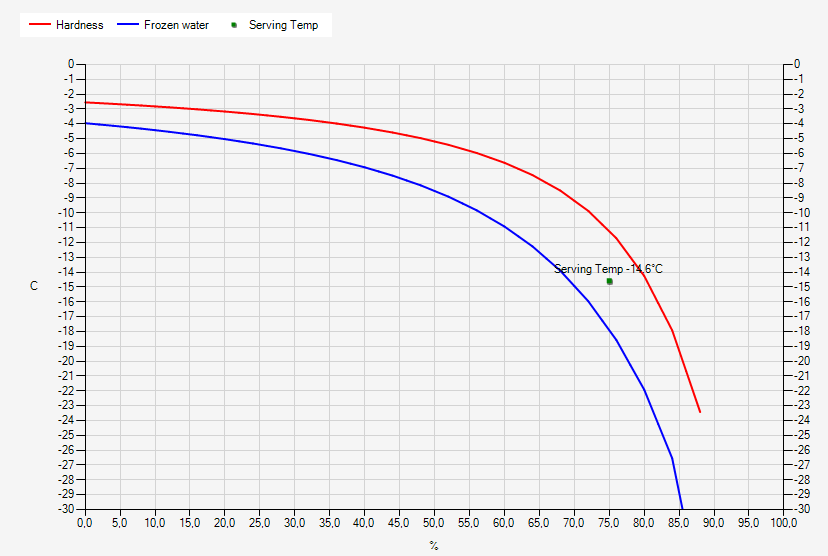
Some ingredients affect the hardness of the ice cream in other ways. The fat and fiber in chocolate and nuts will make your ice cream harder. When calculating hardness this has to be taken into account. You can modify the PAC (like Corvitto) to account for this by setting lower or even negative PAC values for these ingredients. The problem with this is that you will not get a correct initial freezing point calculation. Another way is to calculate the freezing curve using the non-modified PAC values and to adjust the hardness calculation. This is done by a Hardening Factor. The HF acts like a negative PAC and a separate curve can be calculated taking the HF into account. The serving temperature is then approximated using both the freezing curve and the HF curve.
Freezing Curve Revisited
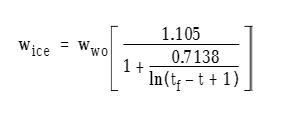
There are other ways to calculate the freezing curve. One popular method is to use this formula from Tchigeov (1979). https://www.researchgate.net/publication/233303640_Evaluation_of_Thermophysical_Property_Models_for_Foods
The blue curve is the freezing curve using the regression method. The green curve is the Tchigeov formula. I know some calculators use this but I don’t find it correct for the type of ice cream I am making.
Hi Sir,
so what is indicator total PAC and POD to make ideal ice cream?
Well, that totally depends on what type of ice cream you like to do.
POD is normally in the 140-190 range
PAC should in my opinion not be used directly, instead we use the Serving Temp calculations from the freezing curve.
Thanks for all this information!
I’d like to read more about the HF hardness factor. I’ve never read about it before. Is there any literature you could recommend?
It’s based on the reduction of PAC from the book “The secrets of ice cream, ice cream without secrets” by Angelo Corvitto and from the Underbelly blog.
Hi, i saw somewhere in this site in the comments section that you consider homemade invert sugar having a lower PAC due to the incomplete process of inverting the sucrose in glucose + frutose. Can you tell me more about it and maybe say some PAC and POD for reference?
Do you think that the incomplete process could be because the temperature of adding cremor tartare?
Thank you!
Commercial invert sugar uses a controlled environment and commercial-strength acids that is hard to achieve in a home environment.
So, homemade invert sugar usually reaches 70%-85% inversion. This means there will be some sucrose in the final product.
The values in the calculator are set to PAC=150 and POD=100. However this is maybe not scientifically correct but this is what is normally used in the industry and in many other calculators.
A more scientifically correct value would be like in this table based on the degree of inversion:
Inversion % | Glucose % | Fructose % | Sucrose % | PAC | POD
60% | 24 | 24 | 22 | 109 | 78.7
70% | 28 | 28 | 14 | 115 | 81.3
80% | 32 | 32 | 6 | 121 | 83.9
90% | 36 | 36 | 0 | 127 | 86.5
Great post and great tool, I’m loving it.
I’m doing some research of the influence of soluble fibers in the free water and I’d like to run some simulations. Could you share the formula to calculate the values of the freezing curve? or is just a lookup in the table of the book you mentioned from Hartel Goff?
Thanks!
It’s mostly based on the Goff formulas but with some modifications.
Please email me on icecreamcalc@gmail.com and we can continue there.