
Freezing point depression
Freezing point depression FPDF or Anti Freezing Power AFP or Potere Anti-Congelante PAC is the lowering of the freezing point of water. When making ice cream this can be used to predict the softness or scoopability at a certain serving temperature. This is especially important in ice cream display cabinets where all the different flavored ice creams must have the same softness. The main ingredients that suppresses the freezing point is SUGAR, SALT and ALCOHOL. You have probably seen in many recipes that you can add a splash of alcohol or a little salt to make the ice cream softer. But the most important ingredient is sugar. By using different types of sugars you can control the sweetness and freezing point of your ice cream. If your ice cream is too hard but has the correct sweetness you can’t just add more sucrose to make it softer you have to use a mix of different sugars.
The freezing point depression in itself is a hint of how soft the ice cream will be, there are other factors to consider as well. If everything else is equal the ice cream with the highest PAC value will be softer. When we calculate the PAC in relation to the water content and look at the freezing curve we get a better measurement of softness.
Science
The science behind freezing point depression is related to the molecular weight of an ingredient. Normal table sugar SUCROSE has a molecular weight of 342 and is used as a reference when calculating PAC.
100g of sucrose in 1000g of water has a PAC of 100
Other types of sugars have different molecular weights and thus affects the freezing point differently. What we do is to calculate the Sucrose Equivalent of any other sugar.
Implementation details
This section is an explanation of how PAC is implemented in the software. There is not a standard way of calculating this. Different sources calculate the PAC and FP in different ways and in different detail. My approach is like this. I calculate the PAC for sugars (PACse or PAC sucrose Equivalent) and use experimental data tables for sucrose solutions to calculate the FP. I then separately calculate the FP for salt, alcohol and for the salts in MSNF. These FPs are then added together to find the final FP. Alternative ways would be to sum the PAC from sugars, salts, alcohol and salts in MSNF to get one final PAC and either use the sucrose table to find the FP or use the linear formula for freezing point depression. So, if you look at other calculators or sources for PAC and freezing point calculations be aware that they might differ from my software both due to different calculations and also of course how the PAC is defined for the ingredients.
Sugars
The most useful sugars in home ice cream making are sucrose, dextrose and fructose. These are all in powder form and is easy to measure and work with. Honey, glucose syrup and other syrups are also common. Lactose is the sugar in milk and also affects the freezing point.
| Sugar | PAC | Relative sweetness POD |
| Sucrose | 100 | 100 |
| Dextrose | 190 | 70 |
| Fructose | 190 | 170 |
| Glucose syrup (DE42) | 80 | 50 |
| Honey | 146 | 94 |
| Lactose | 100 | 16 |
| Salt* | 585 | 0 |
| Alcohol* | 740 | 0 |
Example
To illustrate assume we have the following ingredients.
Water 800g
Sucrose 200g
PAC 200
POD 200
The PAC will be 200 and the POD (relative sweetness) will also be 200. Now we want to keep the relative sweetness and raise the PAC. We can replace some of the sugar with dextrose to accomplish this. Since dextrose only have 70% sweetness compared to sucrose we also need to reduce the water to get the same sweetness.
Water 784g
Sucrose 162g
Dextrose 54g
PAC 265
POD 200
So, by replacing some of the sucrose with dextrose we have kept the sweetness the same but increased the PAC making the ice cream softer.
If we use fructose as well we can use dextrose+fructose to get the same sweetness as sucrose.
Water 800g
Sucrose 150g
Dextrose 35g
Fructose 15g
PAC 245
POD 200
So, we can use a blend of sugars to manipulate the sweetness and the freezing point depression of our ice cream.
Freezing point
All water does not freeze at the same time. Using the PAC we can calculate when the water starts to freeze. This is called the freezing point or FP. So at the FP we have 0% frozen water. When water starts to freeze the concentration of the sugars increases resulting in a higher PAC for the remaining water. Thus we need lower temperatures to freeze more water and so on. This is also the reason why your ice cream machine can not freeze your ice cream completely.
To calculate the freezing point for sugars I use a table of experimental data of sucrose solutions. For salt and alcohol I use a linear formula based on the molality of salt and alcohol.
Freezing curve
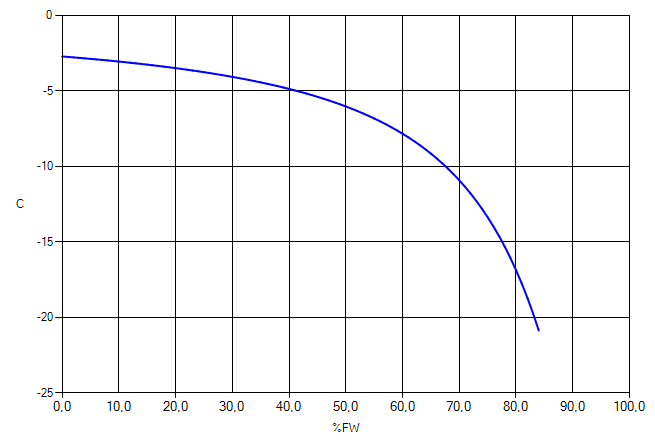
Adding the freezing point for the sugars, salt and alcohol we get the initial freezing point of the ice cream. By simulating more and more water being frozen we can plot a freezing curve. This curve can then be used to calculate the serving temperature of the ice cream or indicate how much water is frozen at a certain temperature. I try to aim for approx 75% frozen water at -14C.
Hi Patrick, thank you very much for your invaluable work.
I’m trying to use a product which is adverteised as Powder Glucose DE21, and for that purpose i’m trying to estimate the PAC and POD values (which are not provided in the technical sheet).
Actually the nutritional values are kinda weird because sugars are quite low, it looks like more something in the middle between Powder Glucose and Maltodextrines.
These are the only known data, is there any way to give a reasonable estimation of the PAC and POD values?
(for 100gr)
Total Moisture: 3,5gr
Total Carbohydrates: 96,5gr.
Sugars: 8gr (Glucose 1,5gr, Maltose 6,5gr)
Other carbohydrates (oligo and polisacch.) 88,5gr.
Dextrose equivalent: 21
Thanks in advance.
You can’t use the nutrition label for glucose powders. The label only have to show the mono- and disaccharides so you don’t know what other sugars the product contains.
I suggest you use the PAC and POD from the Glucose Powder 20DE in the standard database PAC=37 POD=16
Or if you find reliable values from some other source.
Hi, that article helped me a lot! However, I don’t understand 1 thing regarding the example above. Why we had to reduce the water to formulate the second recipe?
In the examples I keep the total weight to 1000g
If I just replace some of the sucrose with dextrose the PAC will increase but the POD will decrease.
(Because dextrose is less sweet than sucrose)
So, to keep the POD constant and increase PAC we need to increase the total amount of sugars and thus to keep the recipe at 1000g we have to decrease water.
Yes I put 25,000 in the POD cell for pure Stevia extract in my gelato and ice cream spreadsheet program. I am making a no sugar gelato recipe now with my spreadsheet program and my recipe only has 1 gram of Stevia extract in it but some people say 1 gram is not enough even though my spreadsheet will tell me that 1 gram is enough. With 1 gram of Stevia extract in my recipe which works out to be 0.02% of the overall amount in my recipe. Including all of my sweeteners that is in my no sugar gelato recipe, my spreadsheet program says that my overall POD for my recipe is 16.3
Thanks ICECREAMCALC you are correct, Do you know the POD for pure Stevie Extract ?
It is 200-300 times sweeter than sugar so a POD of 20000 to 30000
So, as you can see if used in ice cream you will add such a small amount that the PAC becomes irrelevant.
Does anyone know the PAC of pure Stevie Extract ?
Maybe someone else (a chemist) can answer this better but this is what can be googled.
Stevia Powder C44H70O23 has a molecular weight of 967 and that gives a PAC of 35.4
Steviocide C38H60O18 has a molecular weight of 804.8722 and that gives a PAC of 42.5
What exactly pure Stevia extract is and the PAC I don’t know but I think most ice cream calculators set PAC=0 for Stevia.
Right or wrong I don’t know.